
Composed and performed by Gregory Whitehead (7:40)
Based on the text for the third leaflet of the White Rose anti-Nazi movement, written and distributed in the summer of 1942.

WALL INSCRIPTION BY THE WHITE ROSE: DOWN WITH HITLER!
˜˜˜˜˜˜˜
Composed and performed by Gregory Whitehead (7:40)
Based on the text for the third leaflet of the White Rose anti-Nazi movement, written and distributed in the summer of 1942.
WALL INSCRIPTION BY THE WHITE ROSE: DOWN WITH HITLER!
˜˜˜˜˜˜˜
Composed & performed by GW, in commemoration of the White Rose anti-Nazi resistance. Additional vocals by Aimée Anders.
Based on a translation of the White Rose’s second leaflet, distributed in June 1942, including both the quote from Lao-tse and the request to make as many copies as possible, with the word “leaflet” changed to “broadcast”.
Counterpoint quotes are from Hannah Arendt’s definitive study, The Origins of Totalitarianism, published in 1951.

˜
˜˜˜
The tumor broke open
And infected the whole body
Now the end is at hand
When a wave of unrest
Goes through the land
When it is in the air
This catastrophe
Terror without end
can be shaken off
˜˜˜˜˜
“Society is always prone to accept a person offhand for what he pretends to be, so that a crackpot posing as a genius always has a certain chance to be believed.” — Hannah Arendt
˜˜˜˜˜˜˜
Vocals, assorted musical instruments, radio crackle & VLF castaways (11:09).
Created in April 2025, in memory of the White Rose anti—Nazi resistance using sentences and phrases from their first leaflet, distributed in June 1942.
“If everyone waits till someone else makes a start, the messengers of the avenging nemesis will draw incessantly closer.”
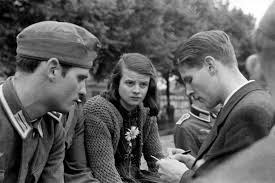
First broadcast on WGXC via the Electroacoustic Poetical Society (EAPS), curated by Marjorie Van Halteran.
˜˜˜˜˜˜˜

A broadcast for the ever-vibrant Radia network that begins with How Still (2024), a disintegrative composition for voice and cosmic crackle inspired by the structure and rhythm of a Langston Hughes poem, featuring a home-made DIY ventilator that fails to sustain the patient.
Then follows May It Come (2024), the title descending from a well-known passage in the Tibetan Book of the Dead, May it come that the sounds of the Bardo shall be known as one’s own sounds.
A freely associative consideration of the Beefheart Affliction; the dangerous game of creating schizophonic monsters; the compost heap of radio’s intrinsic entropy and instability; the creative possibilities released through the fractures of a broken subjectivity; a synthetic voice ripened, to the point of bursting; a piece of flesh that we shall call Figgy Pudding; a bit of brain beneath a fingernail; a scratched radio thanatophony; and a pair of eyes reflecting a Hegelian Night that becomes —- awful.
Both pieces incubated in the fertile regions of the Electroacoustical Poetical Society and its esteemed fellow castaways; thanks to MVH for her bouyance amidst the maelstrom.

(photo credit: Patrick Harkin)
With Edward Abbey, Gelsey Bell, George Bergen, Hilary Deeley, Vanessa Gageos, Helen Hahmann, Nuno Neves, Tiago Schwäbl, Anne Undeland, Laura Vitale and Laura Wiens.
“I am speaking to you now from the edge of a very large swampland. I cannot really see where the water ends and the land begins. Radio play loves edges: between seduction and oblivion; between the raw and the cooked; between the fur and the bone; between infinity and the present tense; between the play and the thing; the value of quiet beaver labor away from the mainstream, reshaping the local landscape as she creates shelter for herself and for her little grand idea that stumbles in, uninvited. But I have no intention of offering neat parables to you, not when I am lying inches away from stinky mud. The sun is going down and in a few more minutes if I stay here I will become food for the mosquitos. It’s time to move on, and so from the Big Sloppy….”

Radio performance based on Carl Sandburg’s Four Preludes on Playthings of the Wind, with vocalist Laura Wiens. Premier broadcast during Radiophrenia festival, 2017.


On the ABC’s outstanding (thus terminated) Soundproof program, in its last weeks:

Radio Unbroken is a songspiel for Radio Revolten made by Helen Hahmann and Gregory Whitehead.
The songspiel uses fragments from the manifestos collected at Radio Revolten, a month-long radio arts festival, which took place in Halle, Germany in October.
Radio Unbroken is composed from three “songs”:
I Lover in Revolt
II The Future of Radio is Dirty
III Radio Unbroken
˜˜˜˜˜
Following the announcement that Soundproof had been cancelled as part of a self-destructive ABC Radio National re-focussing on “digital platforms”, I released the following statement:
Premiere broadcast on the excellent Soundproof program, produced by the Creative Audio Unit at the Australian Broadcasting Corporation:
ON THE SHORE DIMLY SEEN
Gelsey Bell (vocals, improvisation)
Anne Undeland (narration)
Gregory Whitehead (writer, director, montage/composition, vocals)
The interrogation log of detainee 063, as first revealed to the public by Time magazine in 2005, offers a detailed hour-by-hour chronicle of the so-called “special interrogation plan” approved by Donald Rumsfeld and others in the Bush administration during the months following 9/11. In reading through the entire log that records many months of abuse, I was struck by the persistent use of loud music to assault the senses of the detainee; and in particular, the use of the Star Spangled Banner, during which the detainee would be ordered to stand at attention with his hand over his heart.
Verse two of the national anthem begins:

These lines provided me with both a title and a commitment to break the “dread silence” that continues to surround the regime of no-touch torture imposed within Camp Delta at Guantanamo Bay. By responding to the violence of 9/11 with torture, we betrayed our most fundamental values, using our flag and anthem as props in acts of criminal abuse. Yet to this day, despite extensive documentation of extreme human rights violations, not a single perpetrator has been held accountable. What is half-disclosed also remains half-concealed.
At the heart of this broadcast: one day in the no-touch torture of detainee 063, as expressed through my verbatim voicing. Other texts float through and around the log, voiced by Anne Undeland: lists of the approved techniques, brief histories in the development of no-touch torture, excerpts from an interview with Dick Cheney, and analysis of what is happening within the interrogation log itself, ten years after it first came to light.
Extended improvisations by vocalist Gelsey Bell both embody and repel the cruel logic of the texts.
Review and essay here:
From the Limbo Zone of Transmissions
——
GELSEY BELL is a singer, songwriter, and scholar. Described by the New York Times as a “brandy-voiced” “winning soprano” whose performance of her own music is “virtuosic” and “glorious noise,” she has released multiple albums and her work has been presented internationally. She performs regularly as an experimental vocalist, culling from a wide range of techniques and styles to create her own performance works, to literally voice those of contemporary composers, and to explore improvisation.She is a core member of thingNY and Varispeed, and she has worked with numerous performance creators including Robert Ashley, Matthew Barney and Jonathan Bepler, Ne(x)tworks, Kimberly Bartosik, Yasuko Yokoshi, Dave Malloy, Rachel Chavkin, John King, Chris Cochrane and Fast Forward (as the Chutneys), Kate Soper, and Rick Burkhardt, among others. Gelsey also has a PhD from New York University in Performance Studies.
ANNE UNDELAND is an actress based in the Berkshires, widely known for her virtuosic voicing of one-woman shows such as The Belle of Amherst. She has worked with Whitehead on numerous projects for the BBC, including The Loneliest Road and Four Trees Down From Ponte Sisto.
A voice castaway on ABC Australia’s excellent Soundproof program: In memory of Sun Ra during his centennial year.
I attended Haverford College outside of Philadelphia, home base for Sun Ra and his Arkestra during those years. His concerts had an instant deep impact on me, during a time when I was becoming increasingly engaged with jazz and improvisation: the raucous waves of sound; the pure kinetic force and charisma of Sun Ra himself; and the irrepressible joy radiating from the spectacle, as the musicians would circulate at times through the space, completely immersing the audience in the music. We were on a journey somewhere else, somewhere out of this world.
Sun Ra’s philosophy borrowed from many sources, like his music, yet underlying it all was a profound understanding of those soft-burning cosmic vibrations that riddle the universe, if we are open to them. For this memorial piece, I created a compressed version of a more lengthy interview with Sun Ra, and then voiced that text into a simple song, more or less chanted, with very little embellishment. That first voicing then mutates and transforms across seven generations, adding choruses and layers of text and sound. The sources are kept to a minimum: excerpts from the interview, my own voice, and a loop of random ethereal noise, possibly emanating from Saturn.
Like a universe — and then it’s gone.

Commissioned for the 2014 Radio Dreamlands project, conceived by the UK-based Radio Arts.

COLLATERAL MURDER


 For information on broadcast or other rights, contact GW: gregorywhitehead(at)mac.com.
Ongoing explorations into the fate of ciphered disembodies during their slow fade into the electromagnetic night:
˜˜˜˜˜˜˜˜˜˜˜˜˜˜˜˜˜˜˜˜

˜˜˜˜˜˜˜˜˜˜˜˜˜˜˜˜˜˜˜˜

˜˜˜˜˜˜˜˜˜˜˜˜˜˜˜˜˜˜˜˜

CLICK FOR CASTAWAY
An entropic vocal castaway created for the gallerycast/broadcast Haunted Air, curated by Julia Drouhin.


On this, the day that the Mayan calendar runs out of time, I am pleased to enter into the subtle, timeless acoustiplasm of Silence Radio with a new voice castaway, In The End.
Silence Radio is a project sponsored by l’Atelier de création sonore radiophonique , a Brussels-based independent public-funded organization founded in 1996. ACSR’s main purpose is to help beginning producers and artists with their first projects in the realms of creative radio and audio. ACSR is also responsible for a festival named Radiophonic, whose last edition was in 2007, yet with a welcome resurrection promised for November 2013.
SilenceRadio was initiated in 2005 by sound artist-engineer Irvic D’Olivier, in collaboration with (among others) Etienne Noiseau.


SHE COLLECTS THESE
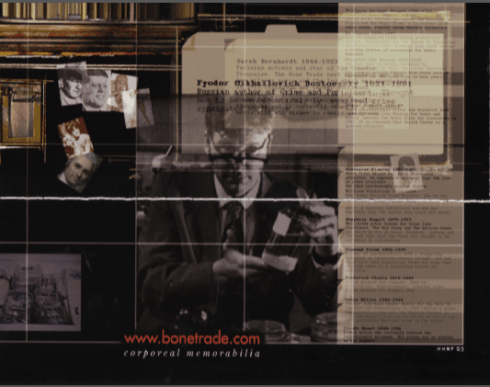
The Bone Trade and central character Walter Sculley have migrated through various media, beginning in 1996.
Sculley’s market for corporeal memorabilia first emerged as part of a BBC radio “conversations with possible people” series Talk to Sleep, produced in collaboration with Goldhawk; then was made into a short film, directed by John Dryden; generated a website, which functioned for a number of years; subsequently published as a dialogue in Cabinet, with an update to follow; and finally, featured as a mixed media installation at Mass Moca, including a series of photomontages by Harry Willis Fleming, who also designed the website and has been a key bone trade affiliate since early days, together with Jane Wildgoose of the Wildgoose Memorial Library.
Even today, Sculley continues to hold forth from time to time on developments within the marketplace.




After the “disappointment” of Y2K, there was a palpable hunger for apocalyptic semiosis in the air; the language of disaster seemed to permeate through all media. Three months later the disaster arrived, with ground zero just a few blocks from Location One.
For the installation, we used three projectors, each section looping independently: Good Morning, Catastrophe and Courage.

ART FORUM.com, June 1, 2001
Assisting on the project were Heather Wagner and François Bucher, who also produced a short video documenting the process, whereby the nine actors responded to audio tape instructions, each in their own style, with additional direction from me: the nine heads in synchrony comprise the Delivery System. Hollywood Squares, following the pulse of The Catastrophe.
October 3,1991, I arrived in Sydney, Australia with little more than a general concept of an Australian Screamscape, carried inside the fictive envelope of an imaginary Institute for Screamscape Studies, of which I was the founding director. Over the following weeks, in collaboration with a small network of associates, we would give voice to a continental nervous system, coaxing the underlying screamscape out into the public airwaves.

EXCERPT FROM SCREAMSCAPE
Everything that happened in, across or through the circuits of the screamscape would become part of the screamscape flow, culminating in a national broadcast. The process followed three stages:
1. The elaboration of a screamscape infrastructure: founding of the Institute, establishing a 24 hour answering machine, called the “screamline” in reference to the acoustic journey that screamers take into their own interior space while screaming; the designation and opening of a dedicated scream room within the Australian Broadcasting Corporation (ABC); and the circulation of “scream discourse” within various news media, via guest appearances on talk shows.

JOURNEY TO THE INTERIOR
2. Monitoring of the scream flow, and the development of various techniques for scream hermeneutics that would allow individual screamers to find their own rightful place within the national screamscape. At this stage, periodic memoranda and reports were circulated through the ABC and the University of Technology regarding the genesis of the screamland and on various aspects of scream theory; econdary publicity accomplished through release of select screams to television and radio programs. Lubricated by discourse and publicity, the scream trickle soon became a flood, in both the scream room and on the screamline, and the producer “nodes” at the Institute began to feel the first effects of The Pressure.
In addition to framing the nervous system, the telephone-microphone-tape recorder-radio circuitry also provided the key for the acoustic demarcation of pressure in the system: distortion, the disruption of digital codes inside the scream room; pure unmanageable noise. The scream as animal energy ruptures signal clarity, exceeding the thresholds of communications technologies not designed to accommodate such vocal intensity.
3. The completion of the circuitry, the breakdown of the last nodes of resistance within our own nervous systems, the passage of all screams fluidly through a now massive network of private and public scream events. Strange things began to happen as we listened again and again to hundreds of “blown” and distorted screams; a networked dreamland turned for a while into screamland blues.
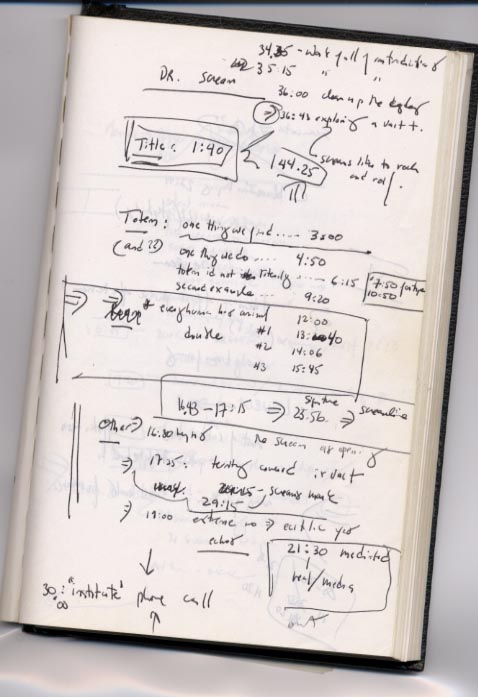
FOR PRIVATE USE; FOR BROADCAST OR OTHER PUBLIC USE, PLEASE EMAIL ME
Last came the national broadcast of the assembled report, transmitted by The Listening Room, followed by additional post-broadcast screamline calls: objections, responses, post-screams, reflections, wrong numbers, confessions, and bold polemics.
Two days after the repeat broadcast, after a moment of silence, the screamline was unplugged, and the nervous system was put to rest; all scream donations were deposited in the “scream bank”, and archived for study by future generations of screamscape researchers. The last memo and ultimatum from the Institute (lodged as it was at the Ultimo ABC) circulated, including a quote from Ludwig Wittgenstein:

At times, the research clinic of the production studio did indeed feel like a psycho-acoustic descent into primeval chaos. Yet the magnificent, affirmative, ecstatic, violent, explosive and celebratory nature of the materials restored us, if not to “home”, at least to a very real, and very human place.
Pressures of the Unspeakable has aired numerous times around the world; the concept has been repeated in different shapes and variations in other countries, sometimes with me present, other times as a distant (or even unknowing) collaborator.
The Australian Screamscape would not have been possible without the help of many associates, most notably the peerless Listening Room executive producer Roz Cheney, whose skill and craft was only matched by her generosity of spirit; the discriminating ears of the brilliant John Jacobs; the unflinching airborn dasein of my mentor and friend, poet Martin Harrison; and of course the hundreds of callers and scream donors, in all their energy and invention.
Click on the screamers below for the complete script.

SCRIPT FOR PRESSURES
An adaptation for BBC radio 4 of a stage play by Normi Noel, itself based on poems, letters and conversations with former Vietnam field nurse, Penny Rock.

We only had two days in the studio (the now sadly closed Looking Glass); a challenging schedule for material of this depth and complexity. Fortunately, Ms. Weaver was equal to the task, and it was a pleasure to work with her, and with her extraordinary voice.
The two days were harrowing, exhausting and exhilarating in equal measure. With the clock ticking down, we found time at the end to have some fun improvising with singing and other vocalizations, which would prove invaluable as transitions and beds. Those final recordings also gave us a way back into the present from the dark and traumatic memory play.
Elements for the sound design included various bass guitar stings and manipulated amplifier throbs and pulses; I also used little noise scraps and tears as acoustic “wounds” to punctuate (and even puncture) the montage; there was no way this space of trauma should ever be made “seamless”. With each scene, I searched for a tone and overall aesthetic that reflected the fractured yet loving (against all odds) qualities in Ms. Rock’s fearless recollections.

EXCERPT: THIS IS TET
For now, at least, the entire play seems to have been uploaded to youtube (not by me):

A final excerpt from the script, with a message that remains all too contemporary:

I first came across a sampling of Sharon Charde’s poetry completely by chance, while browsing through a local women’s magazine. I was instantly struck by the disarming directness and documentary detail in poems that dared to articulate the unspeakable loss of her son Geoffrey while a student abroad, under circumstances that remained obscure, with no known witnesses. At the bottom of the page, there was mention of a forthcoming reading at a library nearby, which I attended. As Sharon read, I was once again moved by the calm precision she was able to bring to the most terrible scenes, and by the rich polyphonies that gave subtle dimension to such a raw wound:

stanza from MOTHER’S DAY AT THE MORGUE
That evening confirmed my sense that her poems, written across three decades, comprised an important body of writing that deserved a wider audience. Fortunately, Sharon agreed to the idea of a BBC radio adaptation, and generously provided me with Geoffrey’s own journals, photographs and documents, as well as many supplementary stories and recollections, some of which I then incorporated into the script. Since her writings obliterate the idea that grief unfolds in tidy linear stages, I became increasingly committed to the fundamental truthfulness of an unresolved narrative structure, where the traumatic moment of the fall remains vivid, through to the very last sound.
We considered many actresses to give voice to the play, though my first choice was always Anne Undeland, who brings an open spirit of brave simplicity and deep insight to everything she does. I knew that Anne had recently performed a one woman show based on the poetry of Emily Dickinson, and she has worked with me on a number of other radio plays, including The Loneliest Road. As it happens, she also lived in Rome during the 1980s, and knew the Trastevere neighborhood where Geoffrey had lived, which helped bring the story fully into the present.

GIVING VOICE TO THE WOUND
For music and sound design, I had in mind the image of a precious Roman mosaic that I had let slip from my hands, and thus it was left for me to piece it together again. There would be jagged edges to be sure – imperfections – and sometimes the edges might cut fingers. To achieve this acoustically, I improvised to recordings of Anne’s voicings on mandolin, bowed psaltery and a cigar box guitar, and then added a variety of sounds to the mix, including the snapping of twigs and the crushing of dry leaves.
I knew Geoffrey liked Simon & Garfunkle, and that he had used a quote from the song “Old Friends” in his High School yearbook. Though I never actually play the song, those chords and rhythms were certainly on my mind as I slowly assembled the final montage.
An informative article by the Litchfield County Times can be found here.
The play will air on BBC Radio 4 on Friday, June 29th. The first three minutes are excerpted here:
Post-broadcast comments on Netartery
From the blog Beyond Goodbye:
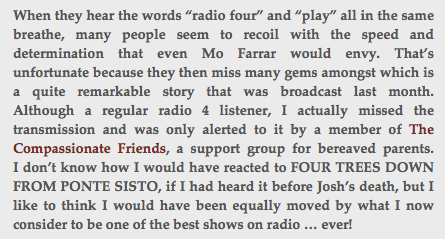
CLICK FOR LINK TO ENTIRE PLAY
A hybrid fiction/documentary produced in close collaboration with Mark Burman for BBC 3’s (relatively) adventurous Between the Ears program.
Mark gathered the interview material with a focus on the history of sound-based weapon systems, and I created the character of Colonel Walter Manley, founder of the Jericho Institute, a shadowy research center with a mission to weaponize the Voice of God (VOG).
Mark also recorded a perfect group clamor from the BBC chorus, as well as a number of shofar blasts, while I created several tonal beds, for texture and continuity. We then gradually composed the montage and mixage, bouncing tracks back and forth between our studios, on either side of the Atlantic, for a February 2006 broadcast.

From Steven Goodman’s fantastic (in every sense) history of sonic warfare:

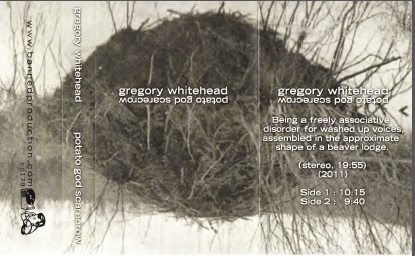
A FREELY ASSOCIATIVE DISORDER FOR WASHED UP VOICES
{Below, excerpted from Mainly the Mysteries.}
I am fascinated by the neurosensual implications of the North American beaver, an artist engineer whose creative capacity is not centralized within its tiny brain but dispersed from head to tail.
To my mind, such capacity has significant implications for narrative structure, and somewhere in the middle of the intricately beavered wetlands, along one of those rich edges where a few loose blazes suggest bright neural pathways cutting through dense limbic muck, a voice says, We have these many many many many mysteries and it’s mainly the mysteries that enthrall me when I’m walking along. A few things I know where they came from, most I don’t.
It is still mainly the mysteries that enthrall me, too, and I still believe in the poetic vitality of edges, which is where the mysteries reside. Edges between eros and thanatos, seduction and oblivion, order and chaos; between sense and nonsense, facts and fables, the living and the dead; between the lover’s whisper and the warrior’s scream. Friction among all these edges still creates ample energy to float my canoe among the beaver lodges.
And yes, I still believe in the power of radio to create community, even for an hour or two, and to feed the imagination with nutrients not offered elsewhere, and I believe that offering such a feast remains a worthy mission for public broadcasting in particular. Diversity is always desirable, and that includes poetic and aesthetic diversity. When we drop these qualities to the bottom of the food chain, we starve our capacity to imagine a viable future for our mysteries.


An anticipatory documentary for BBC radio 3, produced in collaboration with the BBC’s Mark Burman. Based very loosely on the life and writings of Philip K. Dick, whose achievements as a writer and thinker are only now being given their due.

Our structural idea was simple: the weaponized android head of PKD has found its way into the general population; as it passes from hand to hand, the head leaves behind a series of rips and tears in the fabric of reality.
Performed by the talented members of my ensemble of actors here in the Berkshires, all of whom tolerate my directorial idiosyncrasies; and greatly aided by the ears and brain of Nick Zammuto, whose own work has been a major source of inspiration for me in recent years. Also featuring the exquisite voice of Laura Wiens, supported by Billy Sokol on lap steel.


NICO ZED & G. DUB
And finally, one of my favorite quotes from PKD, regarding one of his central literary and philosophical themes, the “authentic human”:

Being, the day King Hammer fell from the sky.
A play in the form of a documentary, examining the aftermath of a shocking fall from the heavens, broadcast on BBC 4 in 2008.
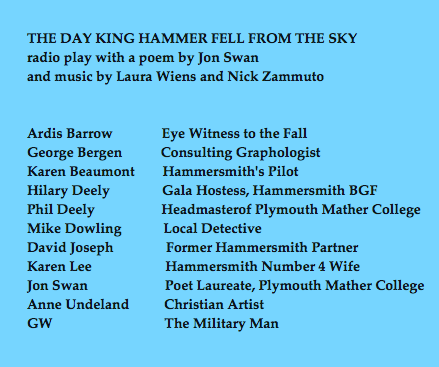
In the summer of 2007, at the bursting point of a historic credit bubble, a famous hedge fund manager named Harry Hammersmith pledges one billion dollars to his beloved Alma Mater, an elite College south of Boston named Plymouth Mather, founded in the year of our Lord 1728 to honor the memory of one Cotton Mather, a distinguished puritan zealot and accomplished witch burner.
Sir Harry Hammersmith, knighted by the Queen of England, and known throughout the financial world as “King Hammer”, plans to deliver his big swinging — gift — in person: at high noon, he shall arrive at the dead center of the Plymouth Mather quad by parachute.
It is a very hot summer day, not a cloud in the sky, seconds before the appointed hour: the elegantly attired guests have assembled upon the freshly mowed green, eager to witness such a sublime moment in the history of philanthropy, the largest single gift ever made to a private institution of higher learning.
Later, during the Kerry Commission Hearings on the Violent and Untimely Death of Sir Harry Hammersmith, a student who had been hired to pour champagne gave the following eyewitness report:


SONG FOR METACOM

____
A radio navigation commissioned by Sound Culture 1996 in San Francisco, with radio works curated by Susan Stone. Produced in close collaboration with Richard Busch, with inspiration from his exquisite Drei Nebel Lieder.
Text derived through the improvisational “dealing” of cards based on Mexican Lotería, liturgical fragments and the maritime alphabet. Performed by GW, Richard Busch and cabaret singer Ilse Pfeifer.

ILSE PFEIFFER: NEBEL-STIMME
Other materials include scraps from a live performance at an International Feature Conference in Basel, and instructional texts on the art of navigation. Sound beds composed by GW and RB. Recorded in the sea-crow media studio on Nantucket Island, over the course of several foggy days in late winter.
Following the premier broadcast on KPFA, Nothing But Fog has aired numerous times throughout Europe, North America and Australia. The below link is for private use within the creative commons; for broadcast or festival rights, please email me.
____
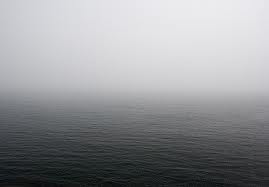
NOTHING BUT FOG


