Archives: 2012

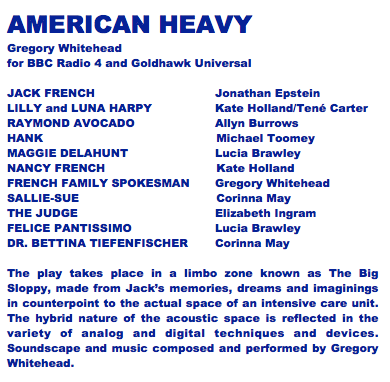
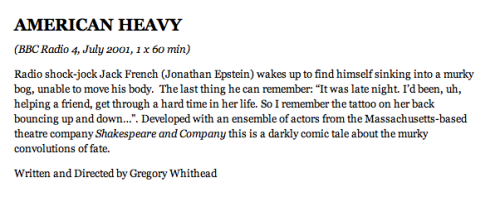
American Heavy

Screen Shot 2013-02-20 at 10.17.54 AM

I confess to harboring a certain perverse fascination for the figure of the Shock Jock, the bottom of the media feed chain, and therefore the most highly paid. The very antithesis of the enlightened highbrow radiomaker, the successful Shock Jock is a relentlessly abusive persona whose combination of manic charm and bottomless cynicism seems to strike at the black heart of our Shining City On A Hill.

opening monologueAH

In 2001, the centennial for Marconi’s famously twitching letter “s”, dot dot dot, the first translatlantic wireless transmission (and yes, I am aware this S may ultimately have been more imagined than real), coincided with the 150th birthday of Herman Melville’s Moby Dick. The coincidence seems apt, as I have long thought of Captain Ahab as America’s first Shock Jock:   Ahab, struck by lightning, and then never stops talking, as he berates, cajoles and ridicules his doomed crew, rants that are supported nocturnally by the tapping of his wooden leg against the quarterboards of the Pequod, an encryption that perhaps only Queequeg understands; Queequeg, whose entire body is a carved cosmogony for his people, and whose coffin is therefore a kind of book box, a box that in turn becomes a lifeboat for the lone survivor, who we call Ishmael — SOS.

AHdialogue

The Shock Jock convenes community, and then puts it to waste, and in so doing replicates in daily, hourly episodes, in a thousand segmented markets, the fallen status of true dialogue in the time zone of this still fairly new yet already battered millenium — and so like this, Jack French sinks into the Big Sloppy:

AH final

CLICK FOR SCRIPT EXCERPT

CLICK FOR SCRIPT EXCERPT: JACK AND JUDGE


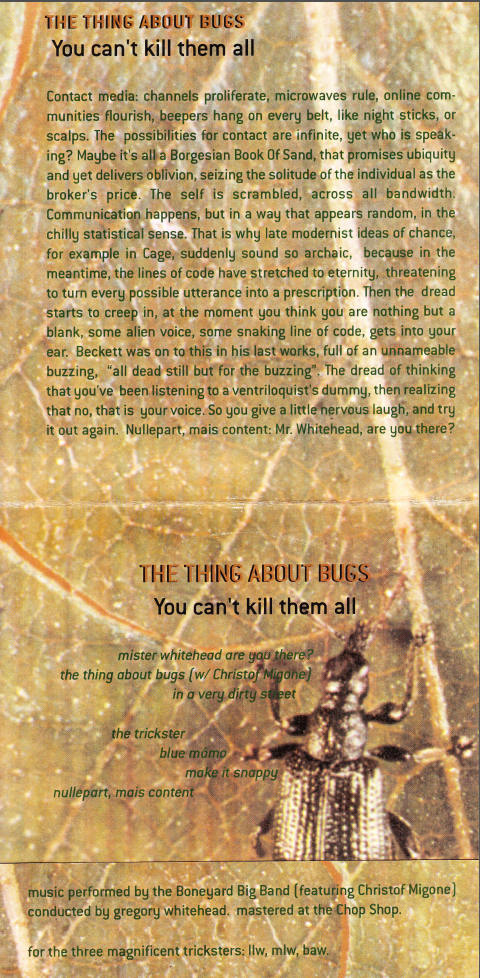
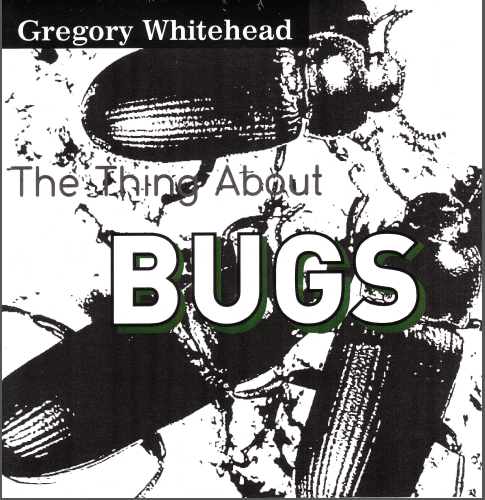
The Thing About Bugs

Etymological radiophony created in collaboration with Christof Migone for New American Radio in 1995. An exploration of deep bug muckmusik, digital hygiene, ethnic cleansing and the True Bug plan of attack.

The process was collaborative at each stage, with raw materials generated through a series of improvisations. Christof was experimenting with mouth mics and various home made noise boxes. We then worked on the raw materials independently, creating brief buggy sub-mixes, which were then finally composed at sea-crow media studio on Nantucket island. GW plays the voice of the etymologist; CM performs as the True Bug, and as a concerned homeowner in search of a final solution.

{The complete BUG OUT, together with other tasty bits of acoustic bush tucker, is available on CD from Generator Sound Art.}


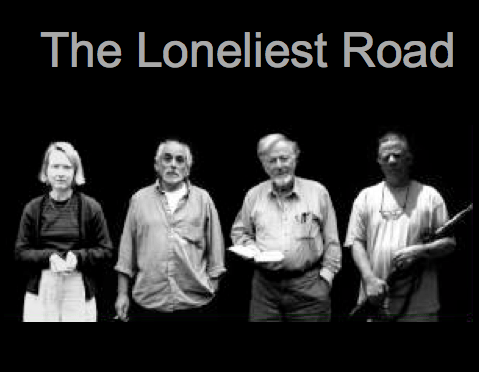
The Loneliest Road

Radio play in the shape of a flight by the Hungry Raven along Route Five Zero in the naked state of Nevada. With music composed and performed by The Books.

First broadcast: BBC Radio 3, October 2003.

CLICK FOR EXCERPT OR PLAY BELOW: LAST FEW MILES OF THE LONELIEST ROAD

Gregory Whitehead, writer and director of The Loneliest Road, interviewed by Gordon House.

GH     So Gregory – where’s The Loneliest Road, and how lonely is it?

GW     The Loneliest Road is an actual road which does exist; it’s the designation for a stretch of highway in the state of Nevada, through a fairly barren desert landscape. But, of course, it’s also a metaphorical road – The Loneliest Road of the American spirit, in every sense of that word, in the year 2003. My objective is to invite the listener on a journey along and over and across this territory via words, sounds and music.

GH     And who are the people we meet on this road?

GW     In addition to the pirate radio host, who calls herself The Hungry Raven, there are two main characters. The first is an individual whose life work has been to memorise the Oxford Anthology of American Poetry. Every word of that anthology he’s able to draw out of his memory and then – in the same way that indigenous cultures would use landscape as a memory device – he’s using The Loneliest Road as a mnemonic device, with mile signs along the road triggering off each poem. So he drives the road back and forth, back and forth, back and forth three rounds trips a week – and it’s a long road. Why? Well, for the answer to that, you have to listen to his interview with The Hungry Raven.

GH     And the second key individual?

GW     An iconic figure of the American imagination, the morally righteous assassin, in this case, one Oswald Norris, born the day Jack Ruby shot Oswald. And unlike the poet, who is constantly in motion, Oswald is fixed in space, looking at cars going by on the road. Now there are not a lot of cars on the Loneliest Road – that’s why it’s The Loneliest Road – but 70 or 80 each day go past him and he “sights in” each one through his rifle, and we overhear him as he imagines the inhabitants of those cars, and unwinds his critique of a fallen America, a critique that is both lucid and slightly mad.

GH     But it’s a metaphorical road as well as a real one?

GW     Yes. And those two characters are the key – poet, assassin, poet, and assassin, turning around and even inside each other; which is which? I believe that’s very much where we are in America right now. There is, always, the Walt Whitman America – the heroic, the genuine romanticism, the idealism of Whitman – that I think is still very much here, though battered. But sometimes the idealism takes on a violent, and even savage tone, often with reference to a Higher Power, which would seem to justify anything. Hear the angel whisper, and pull the trigger. The final chorus of the theme song is “A hungry raven in the sky, a wounded rabbit slow to die; bones piled in the sun, America has all the fun. It’s the Loneliest Road.”

Gregory Whitehead with Oswald Norris (left).


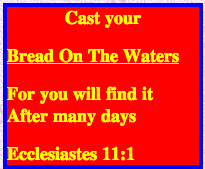
Bread On the Waters

castyourbread

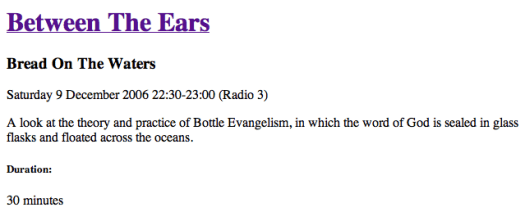
A hybrid documentary with fictive intervention, floating around in the slipstreams of bottle evangelism. Produced in close collaboration with Neil McCarthy, an incomparable gatherer of acoustic sea beans and interview flotsam.

Also featuring the great Jon Swan, as the voice of a local Berkshires bottle evangelist. We sent Mr. Swan his “bio” and then visited him for an interview. Such hybrid techniques were once featured on the adventurous Radio 3 program, Between the Ears.

BOW

0152_bottle_floating_in_water_ani

CLICK FOR EXCERPT


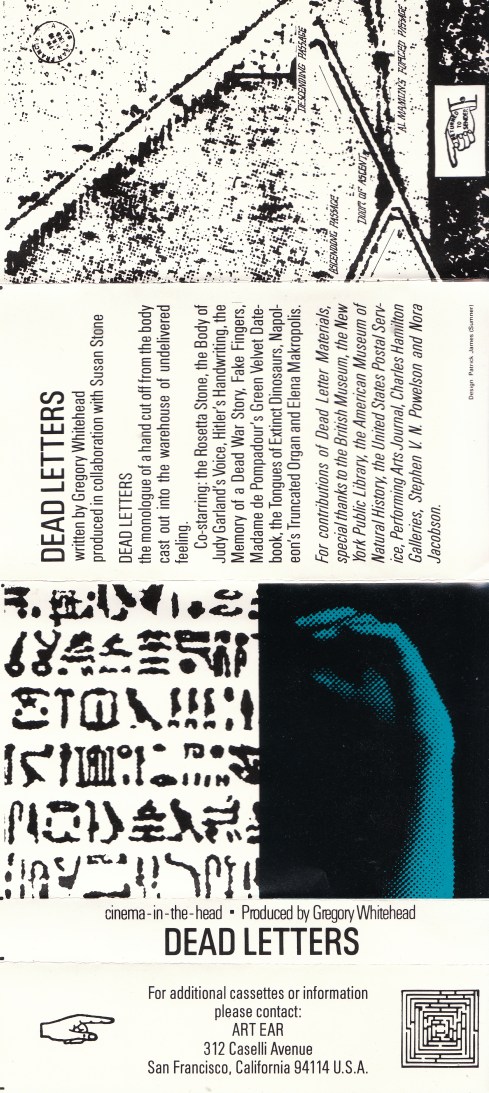
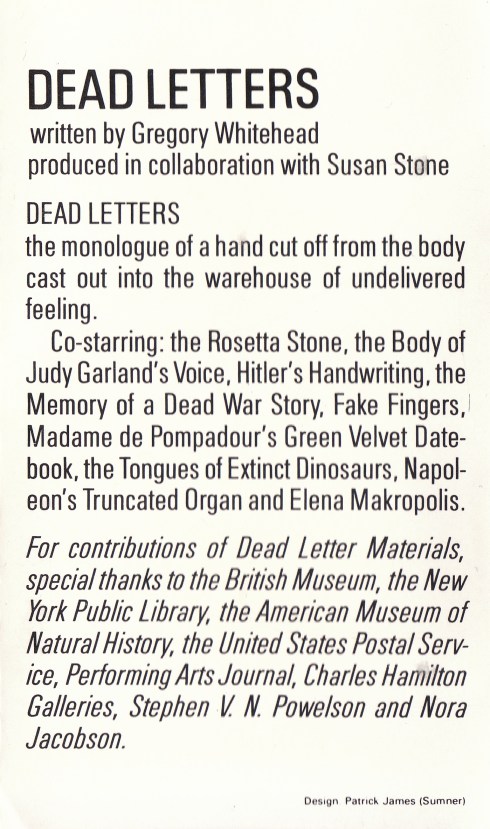
Dead Letters

In 1983, Susan Stone and I received funding from the NPR satellite program development fund for the production of two radio features within a genre we called “cinema in the head”. In my case, this meant an investigation into an assembly of voices, ideas, themes and associations that seemed to belong in the same space, yet had never been properly introduced.

During those years, I was influenced by essayistic films such as Chris Marker’s Sans Soleil (which I still watch once a year or so) and the filmic philosophy of Alexander Kluge. I had also recently finished a master’s thesis about the subjective experience of aurality and literacy, and in particular the work of Walter Ong, whose subtle and deep investigations into the history of the word (and The Word) remains a source of stimulation to this day.

In terms of the production process, I was particularly fascinated by the phenomenology of the analog razor cut as a sort of acoustic emblem for a wounded text; an acoustic text stitched together, where the wounds were active as “mouths” – vulnerable openings among the various floating subjects. Such a text seemed to resonate with the qualities of radiophonic space that have always intrigued me, above all the tense interplay between Eros and Thanatos.

All this led me to visit the New York City Dead Letter Office over the course of several days, watching the small group of skilled decipherers make one last attempt at fulfilling a desired yet possibly doomed epistolary communication. From there, I simply followed whatever associative path was suggested within the language and performance of the interviews themselves.

The editing process was obsessive, as I shaved slivers from slivers to get the rhythm exactly right. Inspired by the dance and music of the Tarantella, the structure circles and spins, offering multiple beginnings and ends; entrances and exits into the warehouse of undelivered feeling.

DEAD LETTERS EXCERPT: first 12:38

Later (ten years later) released on CD by the legendary Staalplaat, which includes a booklet of the entire transcript.


Text/Flesh

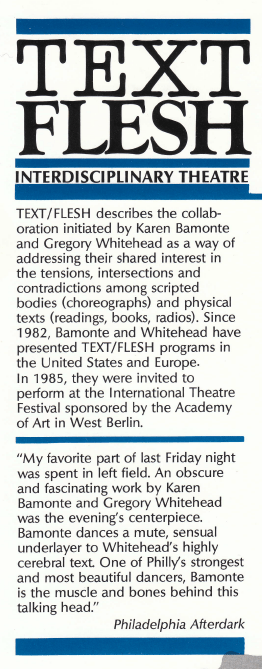
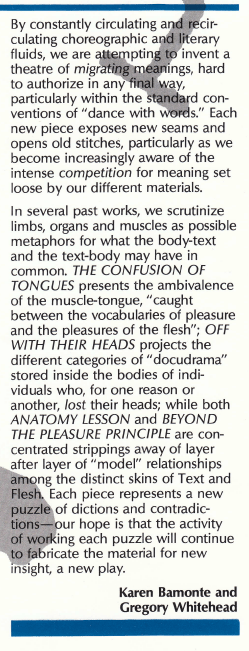
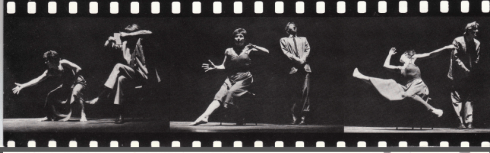
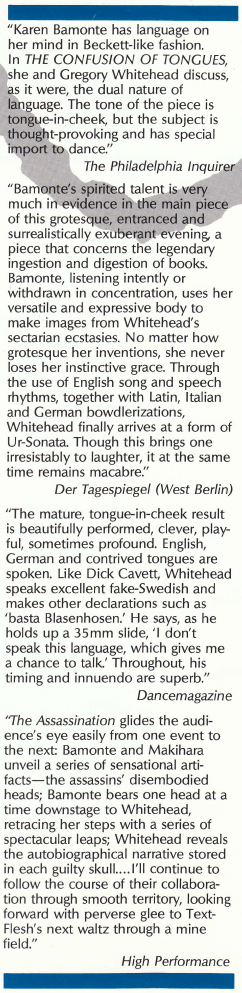
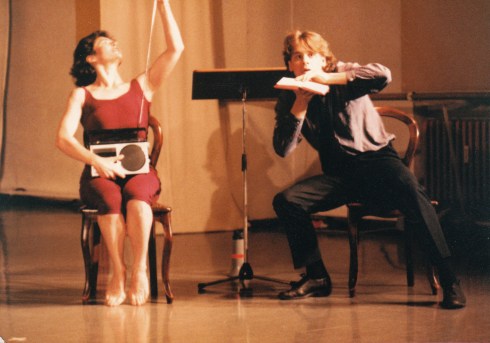
Between 1984 and 1989, I worked intensively with choreographer and dancer Karen Bamonte on a series of pieces that played somewhat tongue-in-cheek with various philosophical and literary ideas about textuality in relation to the body and corporeality in relation to the text.

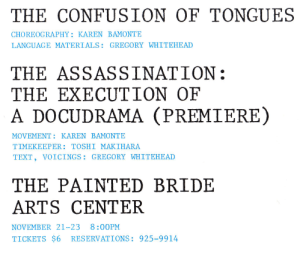
Percussionist/artist Toshi Makihara joined us in 1986, adding rhythmic and “timekeeper” elements. Below, excerpts from our publicity materials, also accessible as a PDF. I have several videos, and will upload them once digitized.

tf2

tf3

tf7

tf6

In Munich….

THE CONFUSION OF TONGUES

THE CONFUSION OF TONGUES

And digisnaps from a Painted Bride postcard, artifact from an analog era…..

tfpc

tfpc2


Writing On Air

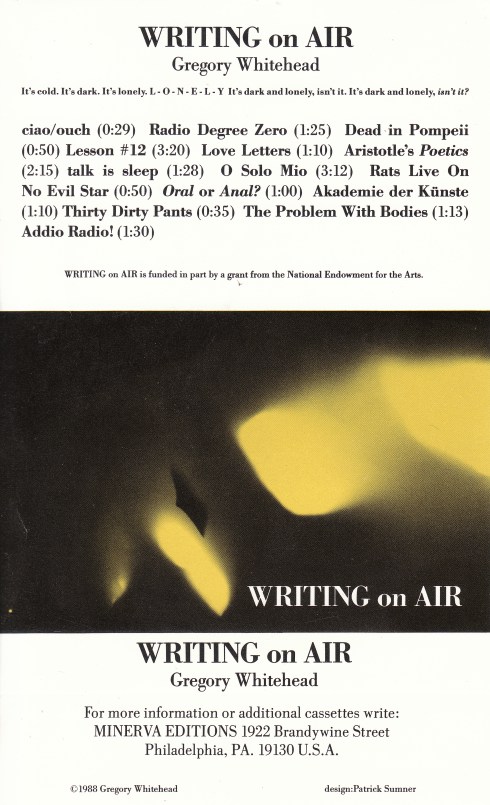
In 1988, inside my studio located behind the garage of a renovated carriage house not far from the gates of the Great Eastern State Penitentiary in Philadelphia, I created a series of “razor castaways” that would embody or (better still) offer resistance to my still rather inchoate ideas about the flight/plight of the schizophonic text.

Process rules: Never take more than one day from start to finish; and let the razor do my thinking whenever possible. With digital production in its infancy, I was still cutting 1/4″ tape by hand, with slivers of voices hanging from tie racks. The resulting collection was then sent forth into the K7 underground as a MINERVA EDITIONS release:

ADDIO RADIO

THE PROBLEM WITH BODIES


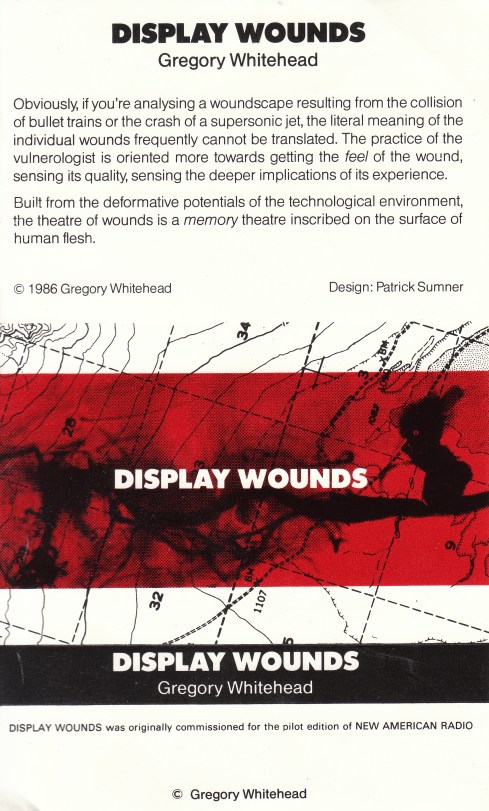
Display Wounds

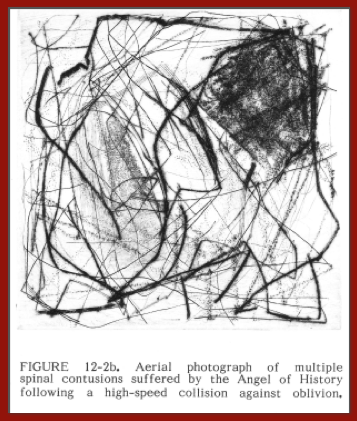
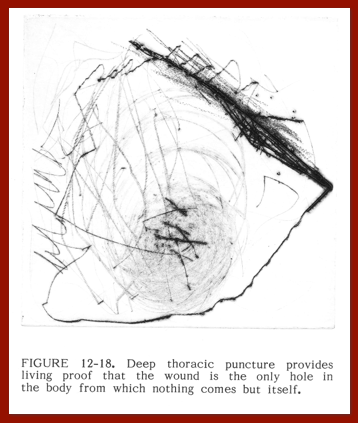
In 1985, while still working on Dead Letters, I became fascinated by the idea of wound reading, and committed myself to the practice of vulnerology, collaborating with Phil Sims on a “wound box” that combined brief caption-texts with his dry point etchings, while also fabricating a series of “wound diddlers” that linked rubber block carvings with surgical tools in a variety of small assemblages; objects that offered a kinetic structure for sustained contemplation of wound contours.

The captions draw from medical text books, plays, cultural theory, art history, hermeneutics and other sources to provide a playful exploration of poetic overtones within the woundscape. A continuous sequence of the wound box caption texts is available here.

With the launch of New American Radio, I then elaborated the caption-texts into the continuous monologue of a “vulnerologist” (played by me, with voice slightly slowed down), using the wound diddlers as props for the vulnerologist, as he poked and carved inside the operating theater.

The related idea of a “woundscape” originates in my experience as a passenger in a near fatal car accident (involving a total of eight people, suffering a wide range of serious injuries that created a complex and multilayered woundscape) on a dark road in rural Maine, when I was sixteen. More on the accident, and it’s many dimensions within the woundscape can be found here.

For a complete transcription of the play, see: Display Wounds: Ruminations of a Vulnerologist, in When Pain Strikes, Theory Out of Bounds volume 14, University of Minnesota Press, 1999.

Critic and theorist Thyrza Goodeve wrote a provocative essay that further explores the notion of an articulate wound: No Wound Ever Speaks For Itself, in Artforum, January 1992.


The Bottom of the Mind

A conversation between a Host and a conjured revolutionary cyclotherapist Guest. Broadcast on the BBC as part of the late-night series TALK TO SLEEP, commissioned by John Dryden/Goldhawk in 1999: an exploration of the ubiquitous radio interview format, yet with GW playing host, guests and all band instruments…..
WALKING THE CIRCLE

THE BOTTOM OF THE MIND

HOST:      “The Bottom of the Mind.” The title sounds — ominous.

GUEST:     It comes from the wonderful sentence by the French poet Paul Valéry, “the bottom of the mind is paved with crossroads.”

HOST:      With “crossroads”?

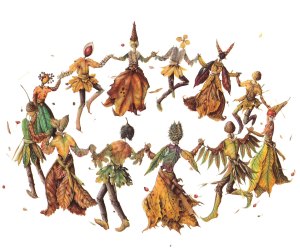
GUEST:       Yes. And my program for self-renewal gains access to those crossroads through a therapeutic technique called “Walking the Circle”, a technique that I have personally experienced for more than ten thousand miles.

HOST:     Ten thousand miles, so that makes it alot more than a twelve step program —

GUEST:     Yes (chuckles) oh, I’ll have to remember that.

HOST:      When I first saw a mention of Walking the Circle in one of the early press releases, I thought it referred to an eco-tourism.

GUEST:   In a sense, that is not too far from the mark, though in my program, the wilderness is a wilderness more of subjectivity than of geography. A subjective wilderness is, uh, far more difficult to access than simply signing on to an exotic safari.

HOST:    You refer somewhere to the “wildness within”?

GUEST:   That’s right. There’s a wonderful quote from the American Thoreau, that I print on the back of my business cards, (hands GW a card), here —- go ahead— read.

HOST:    “It is in vain to dream of a wildness distant from ourselves. There is none such. It is the bog in our brains and bowels, the primitive vigor of Nature in us, that inspires that dream.”

GUEST:     Very good.

HOST:      So Walking the Circle initiates a journey through the wild bog in our brains and bowels?

GUEST:       Yes, though the idea of The Circle is highly polymorphous, in an almost metaphysical way, it’s the Circle of circles, the Circle that circumscribes all other circles of life and being, circles of community, circles of communication, circles of meaning. And of course, each one of these circles has a distinct voice, that must be uncovered and released into the air  —-

HOST:     So what was the, uh, philosophical genesis for your perspective?

GUEST:     While I was a graduate student back in the 1980s, I proposed what at the time was considered quite an eccentric hypothesis, namely that the figure of The Circle was not only a static symbol, but also a highly dynamic opening into latent languages that resided just beneath the surface of collective consciousness, if only we could hear the grooves.

HOST:     And those grooves can only be heard person by person —

GUEST:     That is my hypothesis.

HOST:       So how would I proceed with the basic technique?

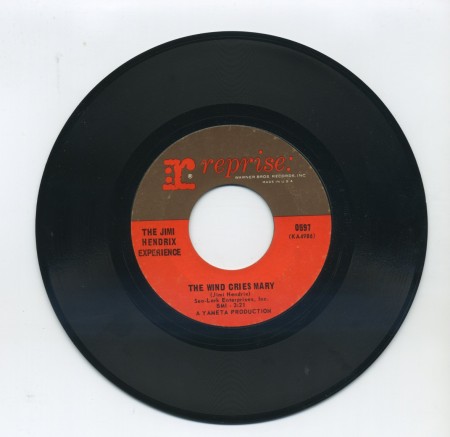
GUEST:    Yes, well, the basic technique emerges from a series of experiments that I performed on myself beginning in the year 1995, and  involves dissolving the self into a circle of time in a way that releases  what I call the existential gramophone.

HOST:      The existential gramophone?

GUEST:     Yes, it’s accessing of the deep self, the deeply inscribed set of voice tracks that are fundamental to our identity, and that must be liberated through a process we call The Essential Broadcast, the only way to know who, or what, is down there.

HOST:      Down there? You mean down at the bottom?

GUEST:       Exactly. Down there where you really are, at those crossroads down at the very bottom of the mind, and we need to give voice to the bottom, and we do so through this technique that we call “puddling”.

HOST:   “Puddling”, or “paddling”? With a “U” or an “A”?

GUEST:       Puddling, with a “U” : it’s a form of broadcasting,  really.

HOST:      Some of the recordings that you’ve played for me, the voices sound inhuman, like they are coming from some dark, distant cave — it’s very unsettling.

GUEST:     Yes, well those recordings are from my own personal grammophone: I do not feel comfortable playing other people’s bottom voices in public, but in my case, I find them very compelling. Listening to them gives me a tremendous sense of well-being, as if simply releasing them into the air is a kind of liberation, and the grooves, the grooves are songs of freedom.

HOST:      But often the song is there, and then it disappears for long periods.

GUEST:   Yes, you see those are the rhythms of identity. Baudelaire said that dispersion and reconstitution of the self, tout est là, that’s the whole story.

THE ESSENTIAL BROADCAST

HOST:     Professor, numerous traditions of psychoanalysis have proposed techniques for getting to the bottom of the self, but most of these involve language in some form. Yet for you, language really has nothing to do with it.

GUEST:       Not exactly. There is a language at the bottom, but it is not one that conforms very well to the psychiatric couch. Talking cures will indeed cure, but it cures the talk, but my technique is beneath the talk, not the articulate memories and symbolic dreams, but the bogs and the bowels.

HOST:     Not a “talking cure” then, but a “walking cure”?

GUEST:    Oh, I really must write some of these down, that’s very good.

HOST:      Is there anything to be afraid of?

GUEST:      Certainly not in the beginning, but as the experiments proceed, let’s just say it would be wise to remain alert to the unanticipated. It’s a kind of dredging, in a way, and when the net comes up, you can’t be surprised if there is more in there than just a few wet fish.

HOST:      So tell me exactly what I have to do.

GUEST:     The first step is to find a private place, one that is open and yet isolated. Next, you establish a circle on the floor of the space, using chalk, or a marker of some sort, or I actually prefer to use colored tape. The circle should  be exactly five feet in diameter, and then you place your tape recorder in the precise center of the circle and you’re ready to roll.

HOST:      And then the journey to the Bottom  involves simply walking along the circle for extended periods?

GUEST:       It begins as a journey, but your ultimate goal is to puddle yourself into the other dimension.

HOST:       The other dimension, I don’t follow you.

GUEST:       Think of it as skipping down into the basement, perhaps. Usually when we say that someone is walking in circles, we mean that they  are caught in a state of entropic suspension,  expending energy and yet never getting anywhere. But my approach is rooted in the many alternative traditions of circle dancing, these are dervishes who enter into the circle of repetition to achieve ecstasy through psychokinetic travel. The standard notion is that ecstasy is in some way an elevation, but I have discovered that the spin to the bottom is far more sublime.

HOST:     So would it be better to dance the circle, then, I mean to really get a full dose of the sublime?

GUEST:      You’re welcome to try, but I suspect you will quickly exhaust yourself. Walking will achieve the same end, and you will have more energy reserved for the important part.

HOST:       The essential broadcast.

GUEST:      That’s right. Giving voice to anything and everything that comes up through the circle, through your nervous system and larynx and out into the world — you need to imagine that at the inner part of the circle is a record for the inner part of your self, and that your feet are frictive needles releasing the information on the record through the application of sustained animal energy.

HOST:      So how long do I have to do this?

GUEST:       I recommend starting with an eight hour session to establish the groove, then gradually work up to the full twenty-four hours, which is when you can really expect the inner record to release some of its more fundamental tunes.

HOST:     Twenty-four hours!

GUEST:       It’s a long way to the bottom.

HOST:       What happens to the essential broadcast once the gramophone has been activated and recorded?

GUEST:     That depends on the client. I have some who hear their broadcast once, and never again, and then are those who put the tapes on endless loop and can never seem to hear enough of them.

HOST:     Do I detect the echo of Narcissus?

GUEST:       You might say that, or you might say simply that some people are more comfortable with their bottoms than others.

HOST:      Is there any one broadcast that sticks out in your memory?

GUEST:     There are many broadcasts, but it would not be ethical to disclose them in this context.

HOST:      Is there any neurological basis for this, that somehow Walking the Circle trigger endorphins which in turn produces the ecstasy?

GUEST:      Possibly, but I believe we have become too reliant on these simple chemical explanations. Remember that the mind is far more complicated than the brain. The brain is an organ lodged inside a fixed skull, but the mind has a locus that is always shifting, it’s very fluid.

HOST:       It occurs to me that the Existential Gramophone is a kind of Time Machine, not unlike Wilhelm Reich’s Orgone Box.

GUEST:     Yes, in a way, though Wilhelm Reich was never able to get out of that box was he, which made the box more of a storage device than a playback machine.

HOST:       Forgive my skepticism but the whole thing sounds like Edgar Allan Poe suddenly deciding to join the New Age.

GUEST:  It’s quite alright. Everybody is skeptical until they master the technique. But I can tell you, from my experience with hundreds of very well-grooved clients, once they feel those needles carving fresh tracks into their wild souls, the problem then becomes how to turn the grammophone off.

HOST:     So there’s pleasure at the bottom?

GUEST:     It — it would seem so.
IT’S A LONG WAY TO THE BOTTOM


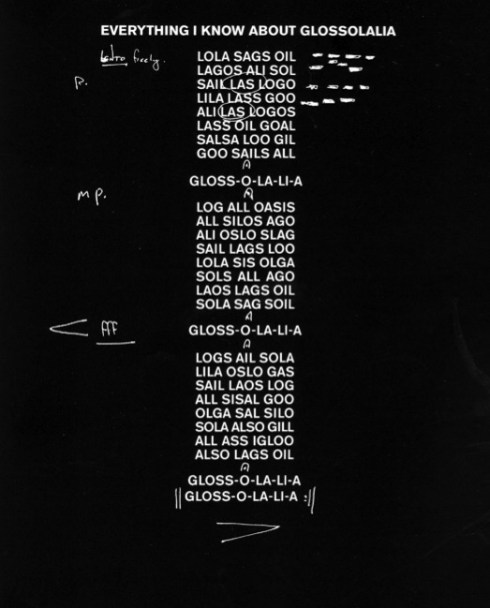
Everything I Know About Glossolalia

LIVE IN PERFORMANCE


Resurrection Ranch

An anticipatory documentary, produced in collaboration with distinguished broadcast journalist Virginia Crompton for the BBC in 2003.

In our view, the most useful documentary would be that which captures the reality before it happens; thus we constructed the Ranch inside a barn here in the Berkshires, briefed our actors on their identities and inclinations, and then set off on an unpredictable journey through the Double R, meticulously documenting the anticipated reality.

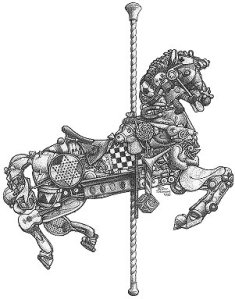
Resurrection Ranch: a luxury service business, where burned out corporate execs and political honchos check in to learn how to “get back into the saddle”. Using recycled merry-go-round horsies as safe and hygienic steeds, the Double R offers guests a sublime (yet safe) adventure into their own existential essences.

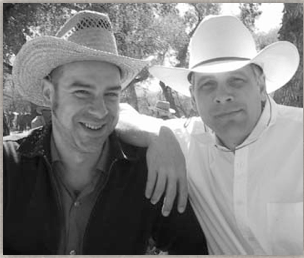
Cowboy hats off, in salute to Virginia, who took a good deal of BBC heat for our little adventure in anticipation. Without her courage and good humor, the Double R would surely never have floated through the airwaves.

EXCERPT: KAT SLADE AND JERRY TRUESDALE

YEEEE HAW!

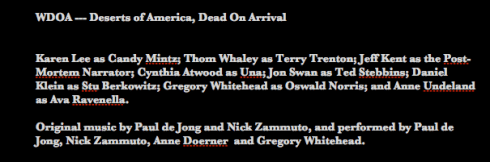
Virginia Crompton as herself; Gregory Whitehead as Jerry Truesdale; Karen Lee as Kat Slade; Jon Swan, Dan Klein and Thom Whaley as RR guests.


On One Lost Hair